Project 30
Anabel Taylor Chapel, Cornell University
Ithaca, New York
2010
In collaboration with GoArt/Lowe
41 Ranks – 2 Manuals & Pedal
Tracker Action
New Instrument & Historic Recreation
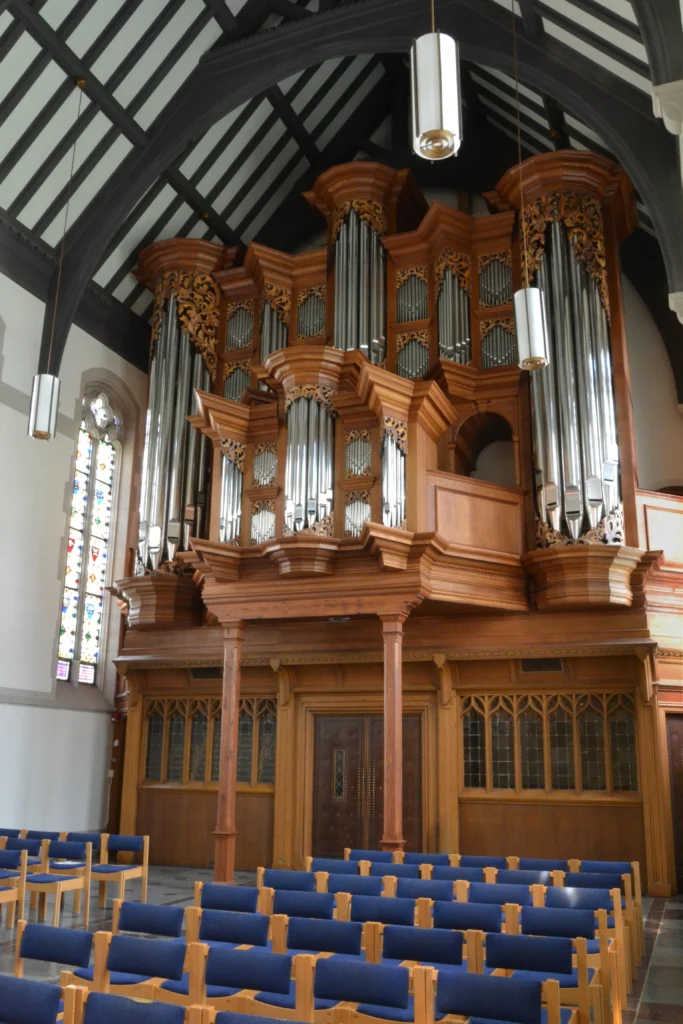
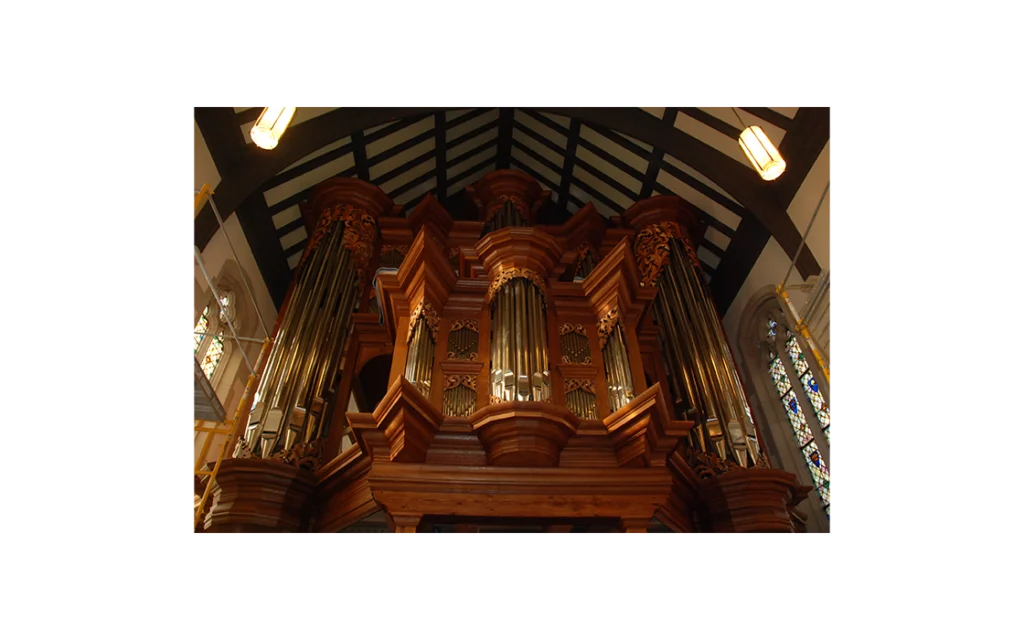
This pipe organ for Cornell University, Anabel Taylor Chapel, is modeled after instruments by 18th Century German organ builder, Arp Schnitger (1648-1719). It was designed and built in collaboration with Göteborg Organ Art Center (GOArt) of Sweden and Christopher Lowe of Ithaca, New York. Under the primary guidance of researcher and organbuilder, Munetaka Yokota of GOArt, the instrument was built using construction techniques and methods common in late 17th and early 18th Century North Germany. Areas of research connected to this project included an historical study into the way in which the Hamburg-based Arp Schnitger worked in cities far from his own workshop. Schnitger’s collaboration with local craftsmen and artists contributed to the particular stylistic quality of late Schnitger instruments.
Tone Quality: The organ’s tonal design is modeled on the Arp Schnitger organ in Berlin at the Charlottenburg-Schlosskapelle (Palace Chapel) (1706) with a few additions to the original specification. The visual layout and design is based on Schnitger’s instrument in Clausthal-Zellerfeld (1702). Due to the significant affect that the chapel acoustic will have on the sound of the organ, the voicing and tonal finishing will take place on site upon completion of the organ installation.
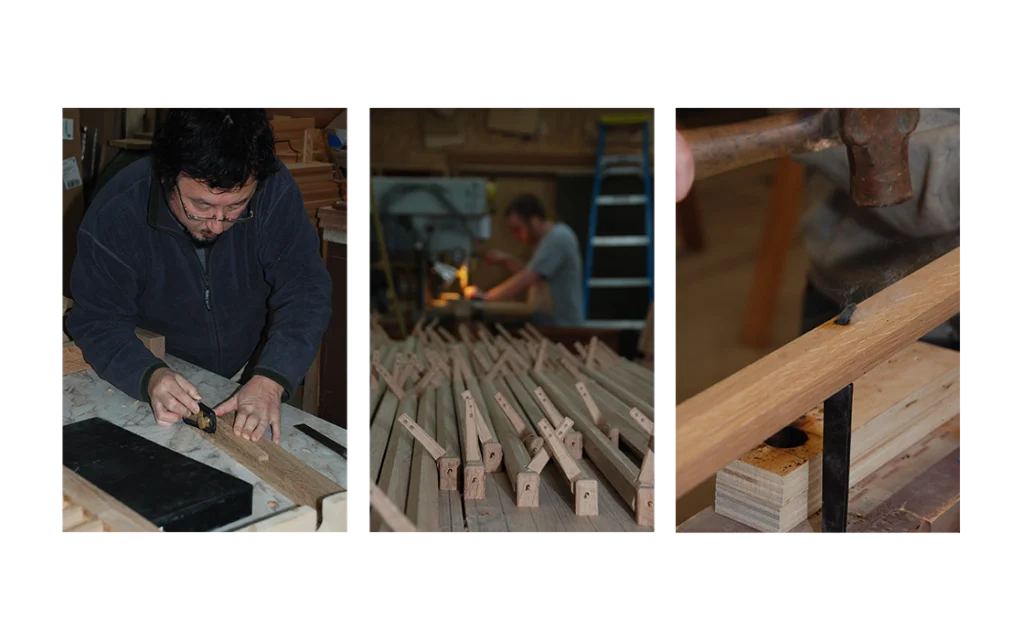
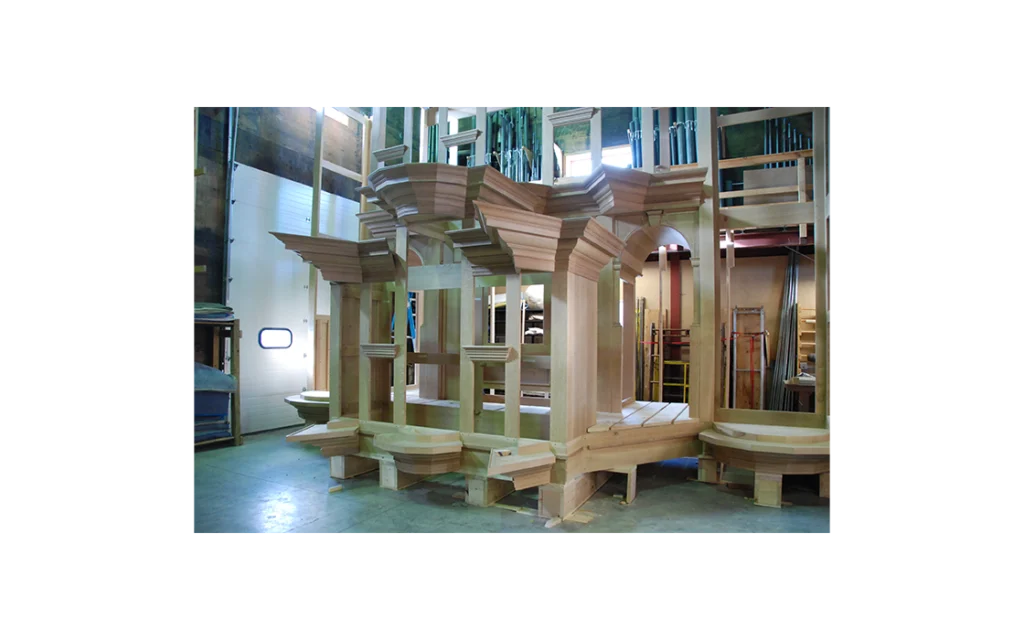
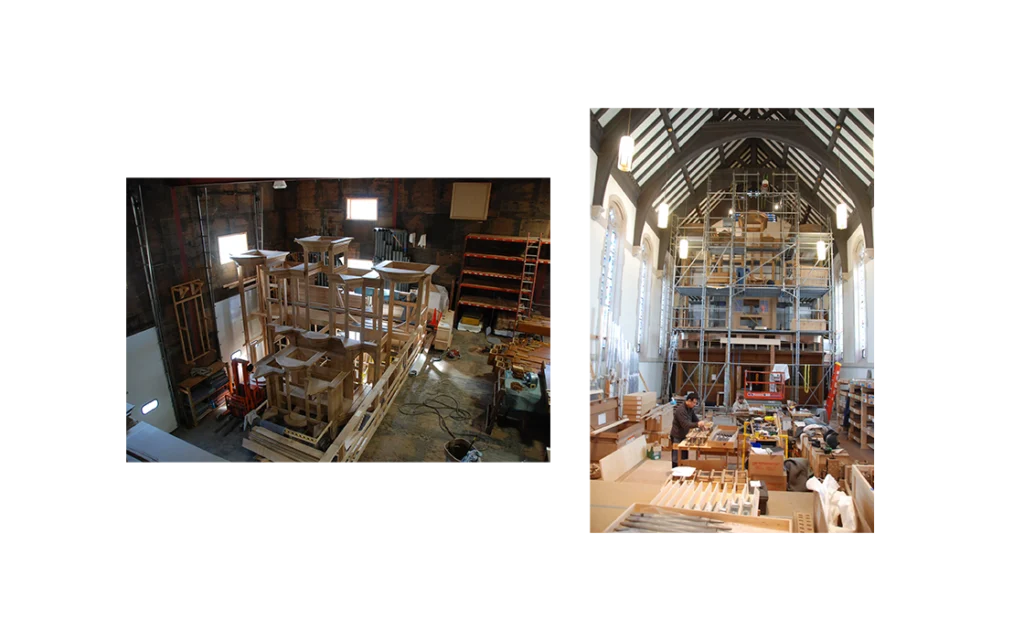
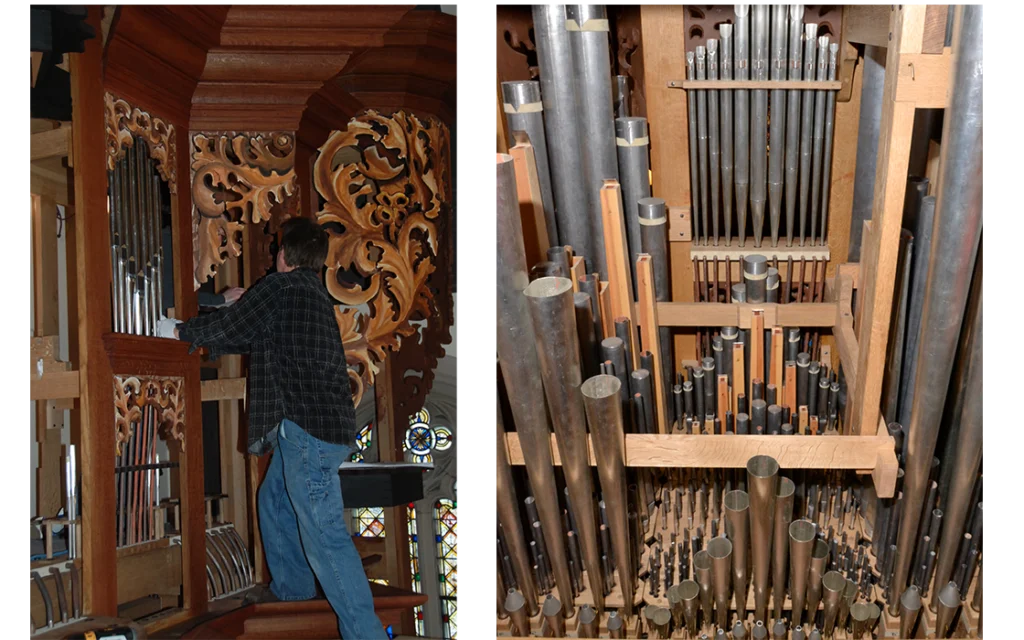
Casework: The case was made by Christopher Lowe and Pete DeBoer in Chris’ small shop outside of Ithaca. As the parts were made, over eleven months, they were assembled in a nearby borrowed barn. It is made entirely of quarter-sawn white oak, mostly domestic. The oak in the long pedal tower frames and the thick posts at the console sides is from Germany. Traditional joints hold the frame together, dovetails, splines, and pegged mortise and tenon. The panels are held together with clenched wrought-iron nails and will have hand forged iron hinges where access is needed for tuning. Modern machines were used for jointing and sizing the parts but it was specified that all the final surfaces be hand smoothed with planes and scrapers. The molding profiles taken from the Schnitger Organ in Clausthal-Zellerfeld, were smoothed with an array of old wooden molding planes and custom-made planes and scrapers. The inside of the panels are finished with an extra deeply scooped texture for its acoustic property. All the oak has been fumed with ammonia to darken it and the exterior surfaces will be rubbed with linseed oil with iron-oxide pigment. The pipe shades are of basswood scroll-sawn to leafy shapes, and are painted by Joel and Karen Speerstra with shadows and details to appear three dimensional.
When asked for guidance on what the finished surface of the moldings should be like, Munetaka responded, “We want to see the tool marks…but they have to be nice tool marks.”
Organ Construction: With each new project comes augmentation of learned skills. Using woodworking techniques consistent with the period was essential toward the project’s success. The organ is made entirely of quarter-sawn white oak. This construction style relies heavily on joinery. Nails, ranging in length from 4” to 5” were hand-forged by a blacksmith in Sweden, along with all the other iron work required for the key and stop action, and the bellows pumping mechanism. Leather was provided by a German supplier using tanning techniques in use during the period.
Bellows: The four bellows can be foot pumped to provide wind pressure to the organ. These will be located in the tower of Anabel Taylor Chapel, approximately 30 feet above and behind the organ. Oak wind conduits will connect these bellows to the organ. An electric blower is also provided to allow for practice without an assistant.
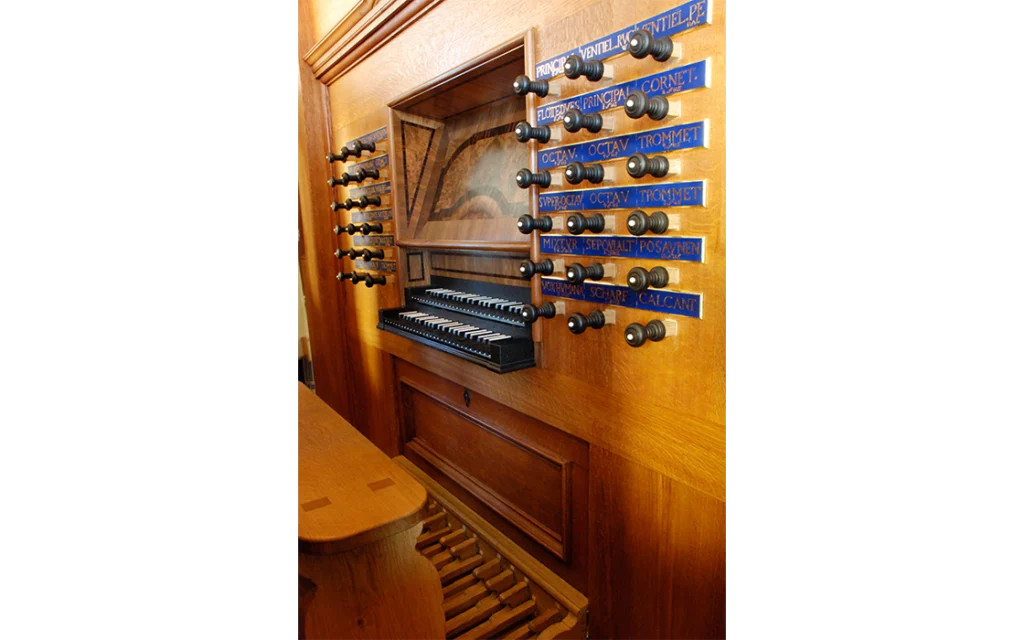
Key and Stop Actions: These are made in a manner consistent with Arp Schnitger’s practice. The key action rollers that transfer key motion from one side of the organ to the other and the stop action trundles that transfer stop knob motion vertically are made of oak. Key action squares that transfer motion 90 degrees are made of iron and were supplied by GOArt. Most trackers (pulling motion) and stickers (pushing motion) are made of oak, and are hand wrapped with twine to strengthen the ends. The ends of the wooden trackers and all of the metal trackers are made of brass wire that has been hand bent in our shop. The key action is suspended, which means that the keys pivot at the tail and hang from the trackers or rest on the stickers from the chest. The Manual key action travels up from the key to the rollerboard which is nailed to the back frame of the organ. The Rückwerk keyboard pushes stickers that carry the action to a rollerboard which is located under the organist. The Pedal key action also relies on stickers which transfer motion to a rollerbox, which carries the motion to the Pedal chests on either side of the organ.
Shop Construction: Organs from the 18th Century were typically constructed on site. When building this organ in the workshop, we have to be able to take it apart. For this reason, the case is pegged together in such a way that it can be disassembled. The case will be glued together when it is finally installed at Cornell. Also, many components that will be nailed in place during the installation are temporarily assembled with screws. All wind line joints will be wrapped with strips of leather which have been dipped in glue to seal them. Those that are fully assembled in the shop are treated this way. Those that will be reassembled at Cornell are temporarily sealed with duct tape.
Pipework: Casting thick metal sheets and then planing metal to the desired thickness by machine produces a weaker material because it removes the hardest metal from the outside. If the handcraft worker has to do everything by hand, then she or he will have the incentive of casting it as close as possible to the desired thickness and with the desired taper, and scraping it minimally but very carefully in the areas where it must be scraped well for acoustical reasons. This much more complex process works with the metal to create a sheet that gives a structural and acoustic result that, almost as a byproduct of the process, is as close as possible to the original Schnitger pipes. What could be called process reconstruction was developed with the goal of reproducing the acoustical quality of the 17th Century organ pipes, and this “process reconstruction philosophy” is applied to the rest of the organ production as much as possible.